Showing posts with label Visual Arts. Show all posts

Monday, March 31, 2014

3C: Integrating Art and Spelling

3C: Integrating Art and Spelling  Animoto Video


  • Students chose a word from their list of spelling words.
  • Then, we discussed the different elements they had learned in Art class. 
  • After, we looked and reviewed the rubric Ms. Krijt uses in class so students could have complete understanding of what was expected, since they were mainly going to be assessed  in CREATIVITY and PLANNING AND EXPLANATION.
  • The final task was to have the students  make a poster using at least 3 elements to describe the meaning of the word  they had chosen.


Sunday, March 30, 2014

Arts Integration and Writing Critiques


Arts Integrations has been the focus of an in-depth action research study within the high school IB Art and Arts Foundations classes. For the last 4 months, I have been collecting data regarding the research process and how to analyze results in a way that minimizes threats to validity and maximizes the effect of the intervention.  The planning stages are complete and the research will take place in the fall of 2014, which will culminate in a thesis paper that reports the findings.  An excerpt from the thesis planning document (found below) explains the research idea and description of the intervention. 

Research question:
Does art integration within the curriculum positively affect the quality of vocabulary, writing skills, and confidence level of our students?


Samples of the Pre Test:  


Research idea:
The student work and reflective entries will be kept in their Investigative Workbooks.  Some samples are included here which show student work (pre intervention) with art critiques, analysis, investigation into visual qualities, and art specific terminology. At the end of the intervention, the students will do another critique and Likert-scale survey to see if there was an increase in descriptive qualities, use of vocabulary, and confidence level.  


The Art integration strategies will include a variety of fine arts disciplines including visual arts, dance, music, and drama. Within these disciplines, a range of approaches are explored including verbal and non-verbal kinesthetic, auditory, and visual activities.


Detailed description 
of the intervention:

For each of the “Arts Integration Interventions,” a new strategy that focuses on vocabulary and descriptive skills will be explored. Students will be introduced to the idea of Arts Integration and how we will practice it within the classroom setting, sometimes in groups, and sometimes individually. At the start of the research, students will create a sample product that, at the high school level, will consist of an art critique. Students will then continue through the unit as normal but will have added Arts Integration activities to supplement their practice. These activities will reinforce observational skills, descriptive skills, interpretive skills, and specific terminology.


Chosen Design
A Two-group pre/post design will be used with this action research intervention. One group of students will receive the arts integration treatment and one group will not.  Both groups will also receive a Likert scale pre/post test that measures their confidence when viewing and talking about art.


Type of Analysis for this Design
A non-paired t test will be used because there will be one group that receives the treatment and one group that does not. A correlation will also be incorporated because student confidence level will be an important component of this treatment.


In addition to the quantitative analysis, the following qualitative techniques will be a main component when analyzing the results.
  • Observations:  Observations will be a component of the analysis, regarding student attitude, participation, and growth in writing skill.
  • Reflection entries:  Reflective entries will be a significant insight into the viewpoints of students on the success/non-success of the arts integration strategies.


Stay tuned for the results...Coming Soon in Fall 2014!


Hand Movements to Recall Art Vocabulary

Third grade students were working on their clay unit and had a hard time learning and recalling the correct vocabulary words used during the actual working process. Students came up with different hand movements for each word and were able to remember the words and their meaning more easily once a movement was related to it.  The movements we came up with are very much associated with the actual act of doing what the word means.


These videos show how even after the unit is over and we are no longer working with clay, students are able to remember the words and the movement associated with it. 


Friday, June 7, 2013

Advanced Art Lab Mural

While not entirely an arts integration project, this mural involved a lot of cross-disciplinary learning. The 8th grade focused a lot on metaphor, figurative language, and symbolism in many of their classes this year. Twelve students in the Advanced Art Lab full-year elective course took these ideas all the way to the completion of a large-scale mural based on the journey through middle school. They used metaphor and symbolism in the images and the narrative of the mural itself, as well as in their narration. Here is a video we put together, which explains the mural's meaning, and shows a cool, time-lapse sequence of the work they did throughout the year. The video was used in a dedication assembly we had this week. Enjoy!


Sunday, March 10, 2013

A Collage Introduction to the Science Curriculum

Science 6 and 7

Science Teacher Adam Fox wanted his students to get an overview of what they would be learning about throughout the year, and he also had some bare walls to fill. He introduced the unit topics, broke the classes into groups, and pulled out a pile of science magazines. The job was to create a collage summarizing what would be studied in each unit, and to come up with an image that would symbolize what that unit was about. The finished collages hang throughout the room, and serve as a reminder to students of what they have studied, and what is to come. They also helped Adam to check their understanding of what each of the topics is about, and help to create a more aesthetic teaching environment.

Adam introduced some collage craftsmanship tips, such as cutting neatly around the outlines of figures, rather than pasting down rectangular picture boxes, and considering the interaction of foreground figure and background image when arranging the photos.


Wednesday, March 6, 2013

Illustrating Poetry: Being Figurative

Language Arts 8

8th grade students were required to write a series of poems as part of their poetry unity. Their teacher, Pat Ludwig, wanted them to produce an illustrated book of their poems. We saw this as an opportunity to extend their thinking about what purpose an illustration serves. They had been working with metaphor, irony, and figurative language in class, and we wanted them to transfer those skills from the realm of language to that of imagery. This is what meaningful arts integration is all about: not merely showering kids with art projects, but using the arts as a vehicle to help them think and communicate in different ways; to understand that each of the arts can come at the same concepts from different angles.

In the slideshows below, you can see the steps we led the students through to reach an understanding of how they could be figurative in their approach to illustrating their poems, followed by examples from their final poetry books. The books were produced using Blurb, and the students were given the option of finding images in royalty-free image databases, or creating their own original artworks. Please note that you may pause the slideshows, or click on them to view a full-sized version.

Thursday, January 17, 2013

Memorials, Monuments, Museums

Social Studies 8

This is an 8th grade Arts Integration Social Studies unit, which looks at societal values, beliefs, and ideals, and how they are enshrined through architecture and the built environment. Students look at the Vietnam Veterans Memorial and other sites they will visit during their class trip to Washington and New York, with attention to what meaning is conveyed through the design of these forms and spaces. The students design a memorial, monument, or museum for their simulation country, and watch a presentation by a local architect. The first slideshow below takes you through the lesson sequence leading into their final design work. Please note that you may pause the slideshow.

Here are three example pieces from start to finish: a museum, a monument, and a memorial. For each piece, you can view the student's process journal, model, and graphic presentation. The students were required to keep a process journal to record their creative thought process through sketches, notes, and photographs. They were also required to write a statement and create a visual graphic to present their final design. Click on the slideshow to view full-sized images in Picasa. Photos of other final models are included in the slideshow as well.

Cuentos de Octavo

Native Spanish 8

8th grade Native Spanish classes wrote their own short stories. We created illustrations for them and published an online book with Blurb.

Tuesday, December 18, 2012

Art Through a Microscope

Science 6

As part of their Cell Biology unit, sixth-grade students work with the microscope to study cells and microscopic organisms. Science Teachers Adam Fox, Abram Cosby, and I developed and taught a short lesson sequence that would teach the students observational drawing skills (which aids their ability to observe and record what they see in the microscope), and also help them to see that the relationship between art and science is a two-way street. Art does not only serve a functional purpose in the scientific process. The observations and understandings derived from the scientific process in turn become inspiration for artists and their work.

The slideshow below gives you a guided tour through the lesson sequence and examples of student work.

Creating Infographics: What is History?

Social Studies 8

Michael Stein-Ross, our Social Studies 8 Teacher, came to me with the idea of having his students create infographics. He was having them devise their own definition of history, and wanted them to be able to give visual form to these ideas. Infographics have become a natural outgrowth of both the information revolution and the increasingly visual nature of our ever-expanding media universe. They vary in quality and eloquence, but the act of creating one provided a nice vehicle for exploring how to communicate an idea or message visually.

 Below is a slideshow that walks you through our lesson sequence, and here are a couple of great resources we found along the way:

"Teaching with Infographics: Places to Start" from the New York Times Learning Network

"A Periodic Table of Visualization Methods" from visual-literacy.org.

Wednesday, November 21, 2012

Google Art Project

Google Art Project is like Google Earth for Art! Select one of the great museums around the world, move through the museum, select an artwork, and then zoom in so close you can see every last brushstroke.

Each day when you go to the site, you will be presented with a new work of art on your screen. It's a great way to really get lost in a painting, and nice tool for regular, brief "looking" sessions in class.

Art Babble


Art Babble is a web-based video site dedicated to all things art. Search and view videos by artist, or go to the many channels hosted by museums and other arts institutions. There are many great, educational videos here.


Timeline of Art History from the Metropolitan Museum of Art


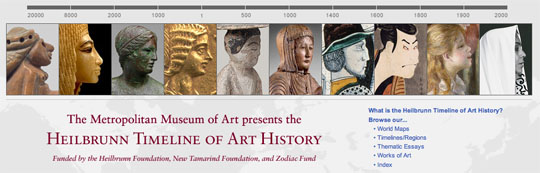
The Helibrunn Timeline of Art History organizes the vast collection of the Metropolitan Museum of Art in New York into searchable thematic timelines. Search by time period, geographical region, medium, or thematic essay. View works as a slideshow, or select an individual piece for extensive background information and analysis. A great research tool for both student and teacher.

Art:21 - Art in the Twenty-first Century

Art:21 is a PBS TV program, now in its 6th season.  Each episode features segments on contemporary artists working around a particular theme.

The shows website has video clips from the program, artist bios, artwork galleries, and downloadable educators' guides to all the programs. A special section titled Using Art:21 Media in the Classroom has helpful tips for incorporating the material in your classes.

There is also an Art:21 Blog with up to date information on contemporary art and artists, as well as opportunities for educators to incorporate contemporary art into their curricula. The program also hosts professional development workshops for teachers. The ECA library has several of the Art:21season DVDs and companion books available.

School Transformation Through Arts Integration: Resources and information from Edutopia


By focusing on the shapes and sounds of Balinese musical instruments (above), Bates Middle School students learn about radius and diameter. Test scores show knowledge retention improving; students say they enjoy learning and feel connected socially. Credit: Zachary Fink

Edutopia is an educational resource network developed by the George Lucas Educational Foundation. In their School Transformation Through Arts Integration section, they have many resources, articles, videos, and lesson plans from Bates Middle School - an Arts Integration model school in Maryland. 

Artful Thinking


Artful Thinking is a method, designed by Harvard University's Project Zero, for developing six thinking dispositions through visual arts. Website includes a full description of the methodology, as well as resources for putting it into practice.

The Outsiders Graffiti Wall


Language Arts 7

Students created a graffiti wall in the classroom of Language Arts Teacher Bill Kartechner, centered around their study of The Outsiders. The classes viewed clips from Style Wars, a documentary film that follows a group of graffiti artists in 1980's New York. There are uncanny parallels between the characters in The Outsiders and the artists portrayed in the film, which lead to rich discussions on group culture, loyalty, identity, slang, and conflict.

Students were shown examples of graffiti. They identified the characteristics of graffiti-style letterforms, and practiced creating their own. Further discussion on The Outsiders identified the key themes, ideas, images, and symbols from the book. After determining which words and ideas should be emphasized on the wall, students began working individually and in pairs on their final designs.

The project allowed students to make parallels between the world of the Outsiders characters, and that of other groups on the margins of society. It required them to recognize, analyze, and evaluate the importance of themes and ideas in the book, while coming to collaborative agreement on visual considerations, such as size, placement, color, and style.

Thursday, November 15, 2012

Science Resources from the Art Institute of Chicago


The Art Institute of Chicago has a website dedicated to the links between science and art. The site is a little dated, but there are lecture videos and lesson ideas here worth checking out.

Saturday, November 3, 2012

ArtsEdge


ArtsEdge, from The Kennedy Center in Washington, DC, is one of the leading Arts Integration resources. The online network is full of lessons, guides, and more.

Mural / Community Public Art Guide


The Community Public Art Guide, from the Chicago Public Art Group is a great resource for your large-scale group or community projects. It offers tips, lists, and guides for creating murals, mosaics, sculptures, and public spaces.